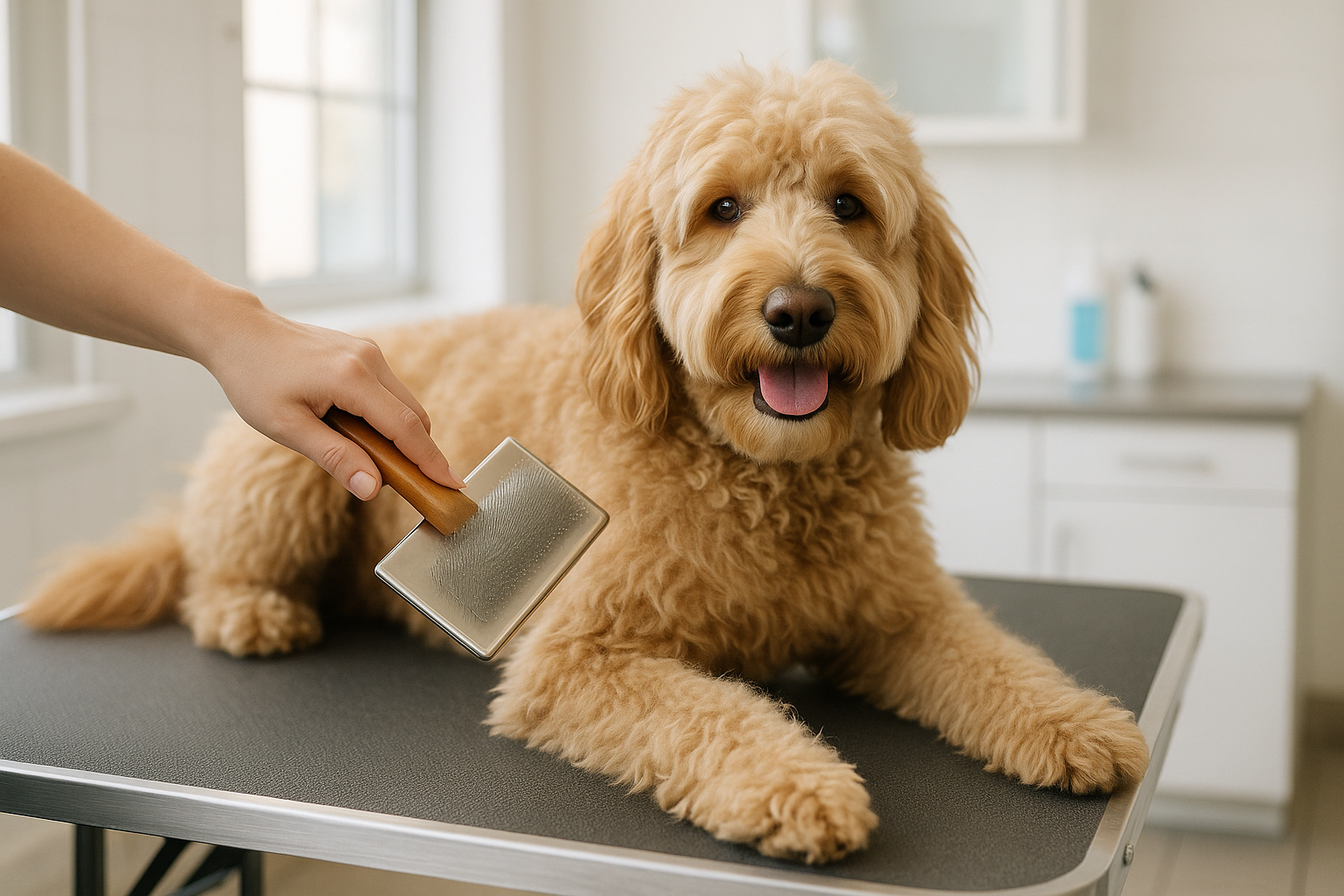
If you have a doodle or poodle, you already know the coat is a commitment. Curly and wavy coats are beautiful, but they mat fast, especially behind the ears, under the legs, and around the collar. The right brush makes a real difference — and so does knowing how to use it properly. At KurlyTails Dog Grooming & Spa in Fuquay-Varina, we see the results of home brushing every single day. Here is an honest breakdown of what tools work, what do not, and how to actually use them between professional grooms.
Why Doodle and Poodle Coats Need Special Attention
Poodles, doodles (goldendoodles, labradoodles, bernedoodles, and others), bichons, and schnauzers share a coat type that does not shed the way a lab or husky does. Instead, loose hair gets caught in the curl and builds up over time. Without regular brushing, that loose hair tangles with healthy hair and forms mats — dense knots that can tighten against the skin and become uncomfortable or even painful for your dog.
The density and curl pattern of your dog’s coat determines exactly how much brushing is needed, but a general rule of thumb is at least two to three sessions per week for most curly coats. If your dog’s coat runs on the wavier or straighter side of the doodle spectrum, you might get away with a little less. If it is tight and curly, you may need to brush more often, especially during high-humidity months — something anyone living in the Fuquay-Varina area knows is a real factor here in North Carolina.
The Three Brushes Every Doodle or Poodle Owner Should Have
- Slicker Brush: This is your primary tool. A slicker brush has fine, short wire pins set in a flexible pad. It works through the top layer of the coat, catches loose hair, and starts breaking up minor tangles before they become mats. Look for one with a comfortable grip and a medium-size head — large enough to cover ground but small enough to work around the face and legs. Use this brush at nearly every brushing session.
- Metal Greyhound Comb: A greyhound comb is how you verify your work. After brushing with a slicker, run the comb through the same sections. If the comb moves through freely from skin to tip, you are done. If it snags, there is still a tangle hiding underneath. This step is the one most owners skip, and it is the reason mats can surprise you even when you think you have been keeping up. Get a comb with both coarse and fine tooth spacing on the same tool — the coarse side for thicker sections, the fine side for around the face and ears.
- Dematting Comb or Splitter: For light tangles that are just starting to form, a dematting comb with slightly curved blades can help you work through the knot without pulling out large chunks of coat. Use this carefully and gently. It is a tool for early-stage tangles, not full mats. If you are pulling hard or your dog is flinching, stop — you are past what home tools can safely handle, and it is time to call a groomer.
How to Brush a Doodle or Poodle Coat the Right Way
Technique matters as much as the tool itself. The biggest mistake owners make is brushing only the surface of the coat. The brush glides over the top, everything looks smooth, but underneath the tangles are growing. Here is how to do it properly:
- Work in small sections. Part the hair and brush from the skin outward, not just from the top down.
- Use a line brushing technique — hold the hair above where you are working to keep the section manageable, then brush a little at a time moving upward through the coat.
- Always finish each section with the metal comb to confirm it is tangle-free all the way to the skin.
- Pay extra attention to friction zones: behind the ears, armpits, groin, collar area, and where a harness sits. These spots mat the fastest.
- Keep sessions calm and positive, especially if your dog is young. Short, consistent sessions are better than one long stressful one.
If you have a new puppy, starting brushing habits early is one of the best things you can do. We offer a Puppy’s First Grooming in Fuquay-Varina, NC that is designed to introduce young dogs to the grooming process gently so they grow up comfortable with it.
When Home Brushing Is Not Enough
Even the most diligent owners end up with a mat situation at some point. Dense mats that are close to the skin cannot and should not be forced out at home — doing so can cause brush burn, skin tears, or real pain for your dog. This is where professional matted dog grooming and de-matting in Fuquay-Varina, NC comes in. A trained groomer can assess what can be saved and what needs to come off, and they can do it safely without traumatizing your dog.
Consistent professional grooming — typically every six to eight weeks for most curly coats — works hand in hand with your home brushing routine. It is not one or the other. The groomer handles the things home tools cannot do, and your brushing between appointments keeps the coat in shape so the professional groom can go smoothly.
At KurlyTails, we specialize in exactly these coat types. If you have a doodle, check out our doodle grooming in Fuquay-Varina, NC page, or if you have a poodle, take a look at our poodle grooming in Fuquay-Varina, NC service. We groom one dog at a time with no kennel time, so your dog is never sitting in a crate waiting — they come in, get groomed, and go home.
We serve dog owners throughout the area, including Holly Springs, Apex, Angier, Willow Spring, and Garner. If your doodle or poodle is due for a professional groom, book an appointment at KurlyTails and we will take it from there.
Leave a Reply